- [2025.11.25] 🎉🎉🎉 We release our survey Deep Research: A systematic Survey. Thanks to my awesome co-authors🤩. Feel free to contact me if you are interested in this topic and want to discuss me.
 A Systematic Survey of Deep Research

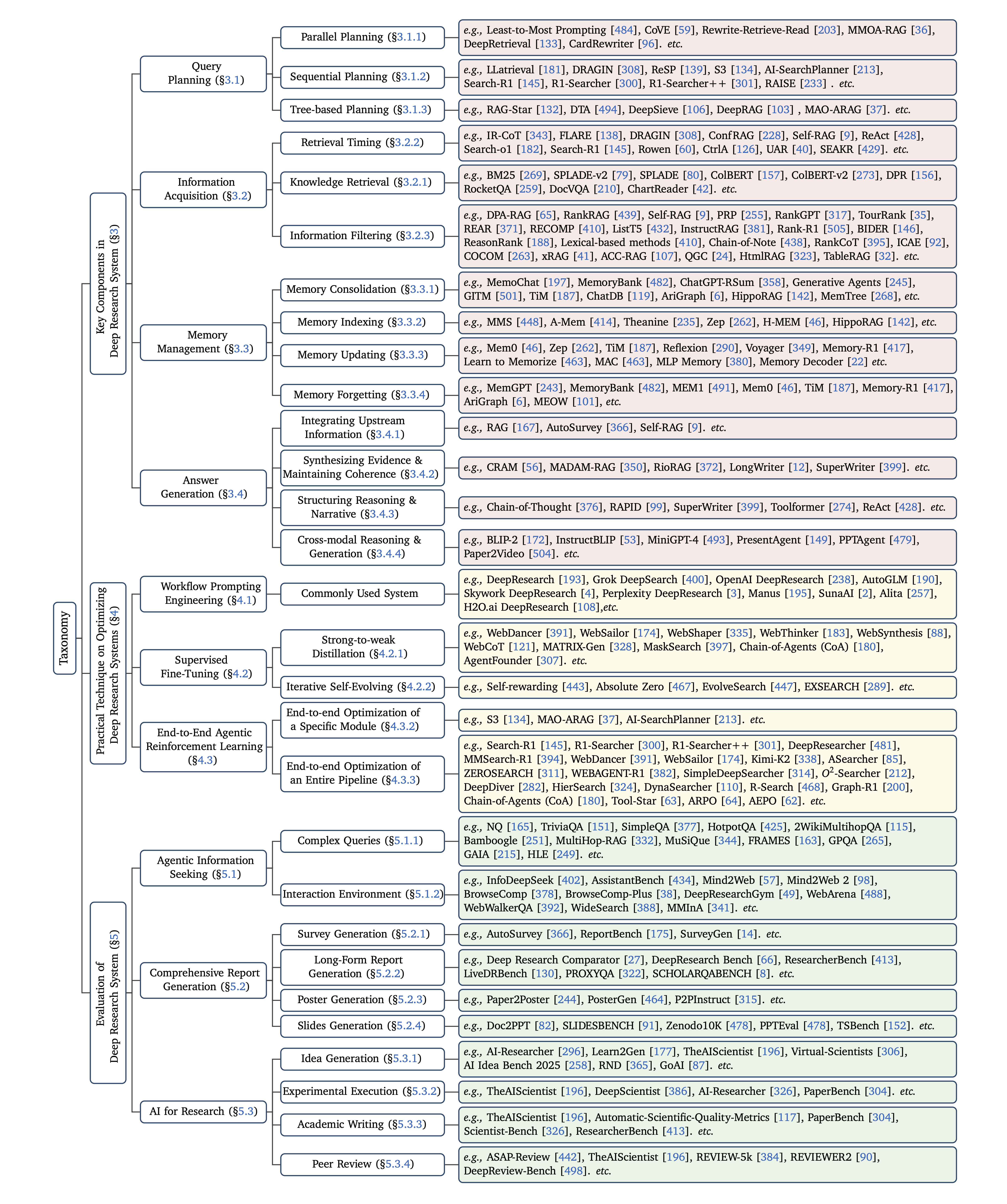
Large language models (LLMs) have rapidly evolved from text generators into powerful problem solvers. Yet, many open tasks demand critical thinking, multi-source, and verifiable outputs, which are beyond single-shot prompting or standard retrieval-augmented generation. Recently, numerous studies have explored Deep Research (DR), which aims to combine the reasoning capabilities of LLMs with external tools, such as search engines, thereby empowering LLMs to act as research agents capable of completing complex, open-ended tasks. This survey presents a comprehensive and systematic overview of deep research systems, including a clear roadmap, foundational components, practical implementation techniques, important challenges, and future directions. Specifically, our main contributions are as follows: (i) we formalize a three-stage roadmap and distinguish deep research from related paradigms; (ii) we introduce four key components: query planning, information acquisition, memory management, and answer generation, each paired with fine-grained sub-taxonomies; (iii) we summarize optimization techniques, including prompting, supervised fine-tuning, and agentic reinforcement learning; and (iv) we consolidate evaluation criteria and open challenges, aiming to guide and facilitate future development. As the field of deep research continues to evolve rapidly, we are committed to continuously updating this survey to reflect the latest progress in this area.
If you find our work useful, please cite:
@misc{shi2025deepresearch,
  title = {Deep Research: A Systematic Survey},
  author = {Shi, Zhengliang and Chen, Yiqun and Li, Haitao and Sun, Weiwei and Ni, Shiyu and Lyu, Yougang and Fan, Run-Ze and Jin, Bowen and Weng, Yixuan and Zhu, Minjun and Xie, Qiujie and Guo, Xinyu and Yang, Qu and Wu, Jiayi and Zhao, Jujia and Tang, Xiaqiang and Ma, Xinbei and Wang, Cunxiang and Mao, Jiaxin and Ai, Qingyao and Huang, Jen-Tse and Wang, Wenxuan and Zhang, Yue and Yang, Yiming and Tu, Zhaopeng and Ren, Zhaochun},
  year = {2025},
  howpublished = {\url{https://github.com/mangopy/Deep-Research-Survey}},
  note = {Accessed: 2025-11-22}
}